Troubled Teen Industry Statistics 2026
Last updated: April 2026
The troubled teen industry — a loosely regulated network of residential treatment centers, wilderness therapy programs, therapeutic boarding schools, and youth boot camps — generates billions in revenue while operating with minimal federal oversight. This page compiles the most current publicly available data on industry size, safety, spending, and accountability.
Table of Contents
- How Big Is the Troubled Teen Industry?
- How Many Deaths Have Occurred in Troubled Teen Programs?
- How Often Are Youth Restrained or Secluded in Treatment Programs?
- How Do Teens Get Placed in These Programs?
- What Federal Oversight Exists for the Troubled Teen Industry?
- Are Facilities Suppressing Information Online?
- Troubled Teen Industry: Key Gaps in Oversight
How Big Is the Troubled Teen Industry?
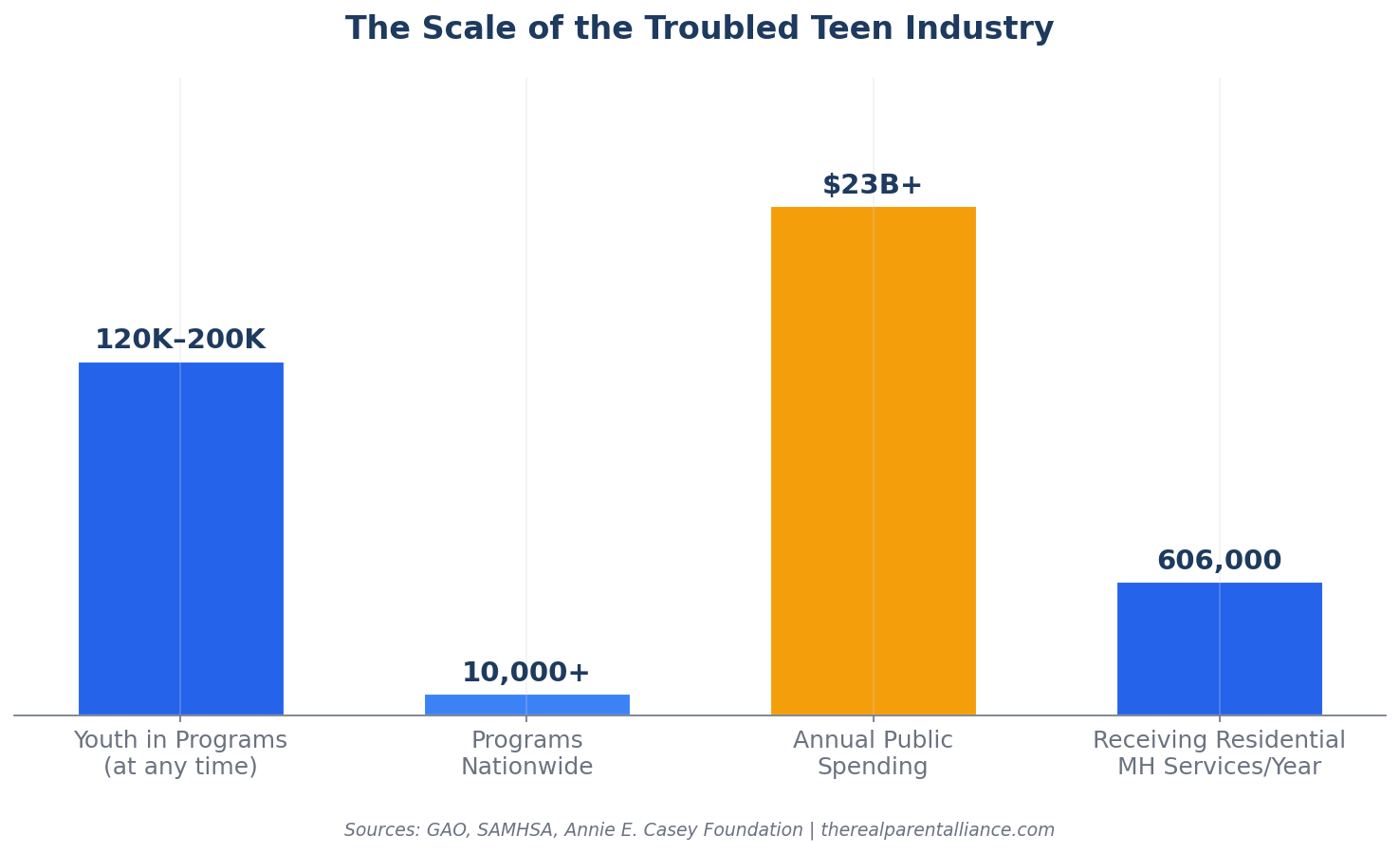
The troubled teen industry encompasses over 10,000 programs nationwide, housing an estimated 120,000 to 200,000 youth at any given time, with annual public spending exceeding $23 billion.
120,000–200,000
Estimated number of youth housed in residential treatment facilities, wilderness programs, therapeutic boarding schools, and boot camps at any given time in the United States.
Source: Government Accountability Office (GAO) — Residential Treatment Programs: Concerns Regarding Abuse and Death (2008 (most recent federal estimate))
10,000+
Estimated number of programs operating under the troubled teen industry umbrella, including residential treatment centers, wilderness therapy, therapeutic boarding schools, and behavior modification facilities.
Source: National Association of Therapeutic Schools and Programs (NATSAP) member directory data (2024)
$23 billion+
Annual public funds spent on residential placements for youth through juvenile justice, child welfare, and mental health systems — not including private-pay placements.
Source: Annie E. Casey Foundation — No Place for Kids: The Case for Reducing Juvenile Incarceration (2023)
606,000
Children and adolescents receiving residential mental health treatment services annually in the United States.
Source: SAMHSA — National Mental Health Services Survey (N-MHSS) (2022)
36,479
Youth in juvenile residential placement facilities on a single census day, including detention centers, group homes, and residential treatment centers.
Source: OJJDP — Census of Juveniles in Residential Placement (2021)
How Many Deaths Have Occurred in Troubled Teen Programs?
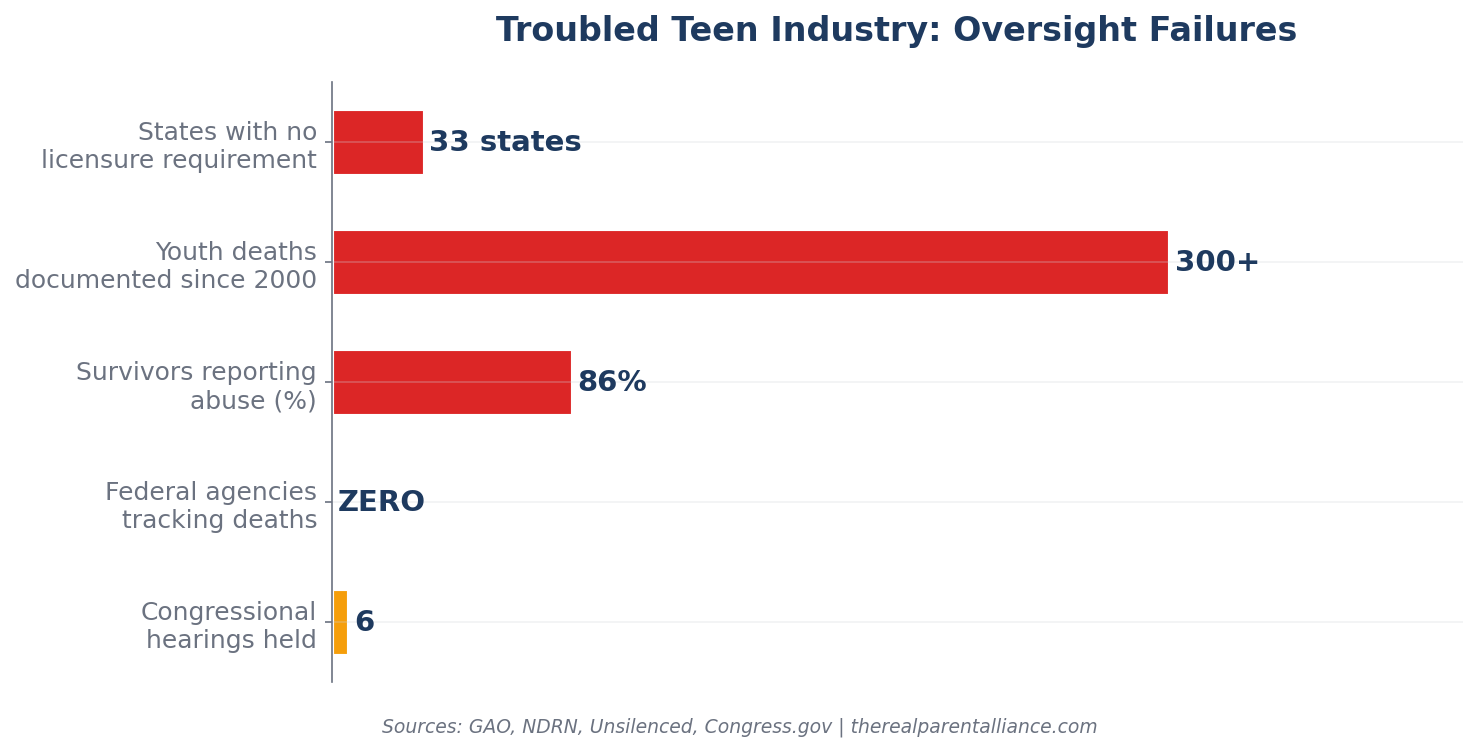
At least 300 youth deaths have been documented in residential treatment programs since 2000. The true number is likely higher because there is no federal requirement for facilities to report deaths or serious incidents.
300+
Documented deaths of youth in residential treatment programs, boot camps, and wilderness therapy since 2000. Includes restraint-related deaths, suicide, medical neglect, and heat exposure.
Source: Unsilenced — Youth in Congregate Care Death Database (2000–2024)
0
Number of federal agencies that systematically track deaths in private residential treatment facilities for youth. There is no national reporting requirement.
Source: GAO — Residential Treatment Programs: Concerns Regarding Abuse and Death in Certain Programs for Troubled Youth (2008)
33 states
States that have no licensure requirement for residential treatment programs for youth, or exempt certain program types from licensing.
Source: National Disability Rights Network (NDRN) — Deception and Danger: States that Fail to Regulate Residential Treatment Programs (2023)
86%
Percentage of surveyed residential treatment program survivors who reported experiencing abuse — including physical restraint, isolation, verbal abuse, or deprivation of basic needs.
Source: Unsilenced — 2023 Survivor Impact Survey Results (2023)
1,619
Allegations of abuse or neglect in residential child care facilities reported to state licensing agencies in a single year, according to a Senate investigation.
Source: U.S. Senate HELP Committee — Staff Report on Residential Programs (2022)
Note: The true death toll is almost certainly higher than documented. There is no mandatory federal reporting requirement for deaths in private residential treatment facilities, so data relies on news reports, lawsuits, and state records that advocates have compiled voluntarily.
How Often Are Youth Restrained or Secluded in Treatment Programs?
Federal data shows thousands of restraint and seclusion incidents in youth residential facilities each year. There are no federal limits on the use of physical restraint, prone restraint, or seclusion rooms in private residential treatment programs.
No federal limits
There are currently no federal regulations governing the use of physical restraint, chemical restraint, or seclusion in private residential treatment facilities for youth. Some states have enacted restrictions, but coverage is inconsistent.
Source: GAO — HHS Guidance Could Help Address Concerns about Residential Treatment Programs (2008)
70%+
Percentage of congregate care survivors who reported being physically restrained during their placement, according to a national survivor survey.
Source: Unsilenced — 2023 Survivor Impact Survey Results (2023)
40%+
Percentage of surveyed survivors who reported being placed in seclusion (locked alone in a room) during their residential placement.
Source: Unsilenced — 2023 Survivor Impact Survey Results (2023)
Note: Restraint-related deaths are among the most common causes of death documented in residential treatment facilities. The SICAA legislation would ban prone (face-down) restraint and establish limits on seclusion for the first time at the federal level.
How Do Teens Get Placed in These Programs?
Many parents find programs through educational consultants or online directories. Some consultants receive referral fees of $4,000–$10,000+ per enrollment from facilities, creating a financial incentive to recommend specific programs regardless of fit.
$4,000–$10,000+
Typical per-enrollment referral fee paid by residential treatment facilities to educational consultants and placement agencies. Some facilities disclose these fees in their own legal agreements.
Source: TRPA investigation — facility legal disclosures and Exceed Marketing filings (2025–2026)
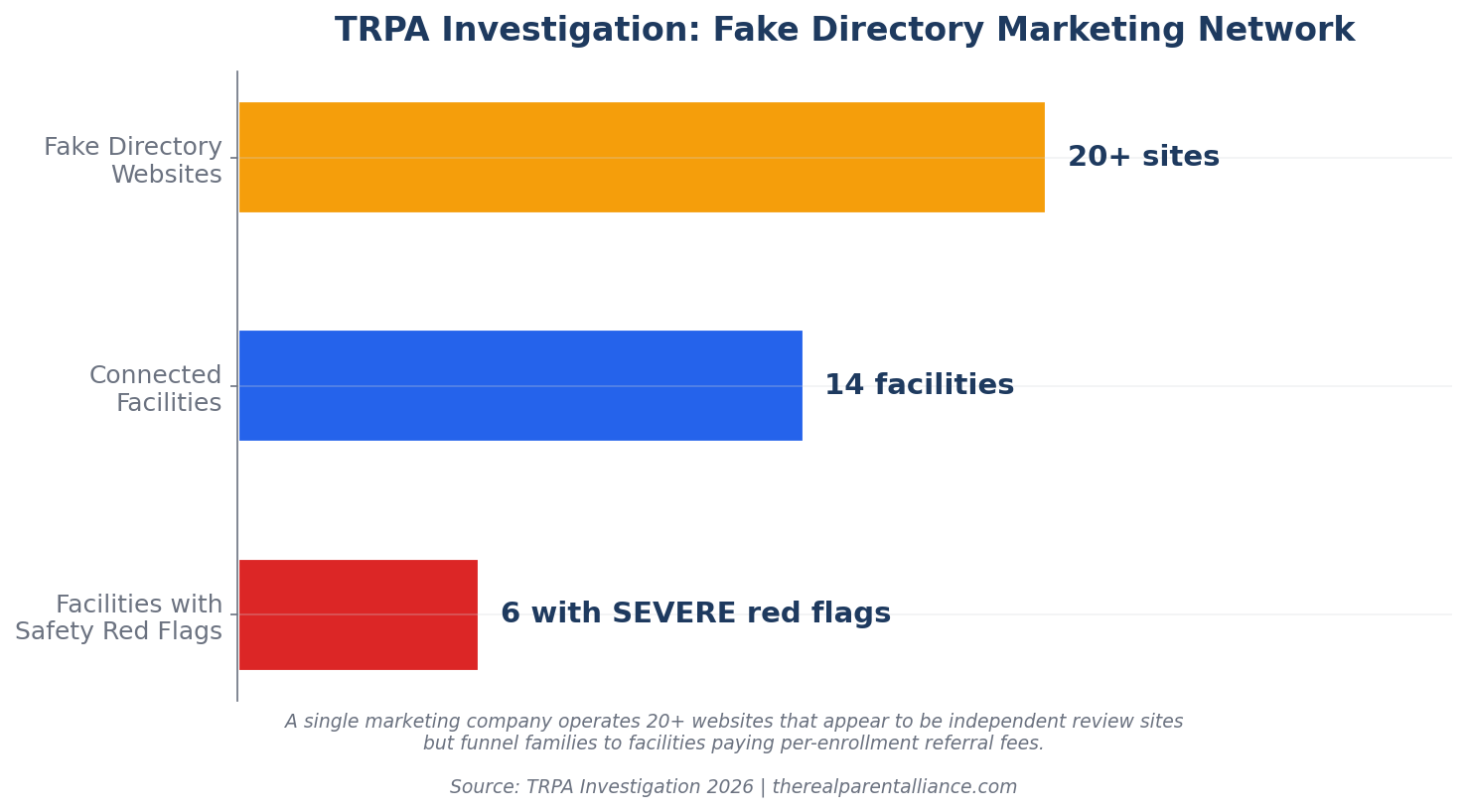
20+
Number of fake directory websites identified in the TRPA investigation that appear to be independent review sites but are operated by a single marketing company (Exceed Marketing / Best Choice Treatment) to funnel enrollments to paying facilities.
Source: TRPA investigation — domain registration and content analysis (2026)
6 of 15
Of 15 facilities featured on a single marketing network's directory sites, 6 had severe safety red flags including abuse allegations, license revocations, or lawsuits documented in public records.
Source: TRPA investigation — public records analysis (2026)
66%
Percentage of youth in residential treatment who are placed through juvenile justice or child welfare systems rather than by parents seeking private placement.
Source: OJJDP — Juveniles in Residential Placement (2022)
Note: Not all educational consultants accept referral fees. Organizations like IECA (Independent Educational Consultants Association) prohibit fee-based referrals among their members. However, there is no licensing requirement to call yourself an educational consultant, and no federal regulation of referral fees in this industry.
What Federal Oversight Exists for the Troubled Teen Industry?
There is currently no comprehensive federal regulation of the troubled teen industry. The Stop Institutional Child Abuse Act (SICAA) has been introduced in Congress multiple times but has not yet passed.
6
Congressional hearings held on abuse and deaths in residential treatment programs for youth between 2007 and 2024.
Source: Senate HELP Committee — Hearings on Residential Treatment Programs (2007–2024)
SICAA
The Stop Institutional Child Abuse Act — bipartisan legislation introduced by Sen. Jeff Merkley and Rep. Ro Khanna that would establish federal standards including a bill of rights for youth in congregate care, ban on prone restraint, and mandatory incident reporting. Has been introduced multiple times since 2021.
Source: Congress.gov — S.1351: Stop Institutional Child Abuse Act (2021–2024)
2021
Year Paris Hilton testified before Congress about her experience at Provo Canyon School in Utah, bringing mainstream media attention to institutional abuse of youth in residential programs.
Source: Senate Judiciary Committee — Testimony of Paris Hilton (2021)
2008
Year the GAO published its landmark investigation documenting abuse and death in residential treatment programs for youth, which remains the most cited federal report on the industry.
Source: GAO — Cases of Child Abuse and Death in Residential Programs for Troubled Youth (2008)
Note: Despite multiple Congressional hearings and bipartisan support, no comprehensive federal regulation of private residential treatment facilities has been enacted as of April 2026.
Are Facilities Suppressing Information Online?
A TRPA investigation found that at least 14 facilities are connected to a marketing network that uses AI-generated content and fake directory websites to suppress survivor testimony and abuse reports in search results.
14
Residential treatment facilities confirmed in a TRPA investigation to be connected to a marketing network (Exceed Marketing / Best Choice Treatment) using AI-generated content, fake directory sites, and SEO manipulation to suppress negative search results including survivor testimony.
Source: TRPA investigation — documented in full briefing report (2026)
20+
Fake directory and review websites identified as part of the same marketing network, designed to appear as independent resources but controlled by a single entity to manipulate search results for facility names.
Source: TRPA investigation — domain registration and WHOIS analysis (2026)
Note: All claims in this section are based on TRPA's own investigation and are documented with domain registration records, content analysis, and the facilities' own published legal disclosures. Full investigation documentation is available on request.
Troubled Teen Industry: Key Gaps in Oversight
| Area | Current Status | What SICAA Would Change |
|---|---|---|
| Federal licensing standard | None — varies by state | National baseline standards |
| Death/incident reporting | No federal requirement | Mandatory reporting to HHS |
| Restraint/seclusion rules | No federal ban | Ban on prone restraint, limits on isolation |
| Youth bill of rights | Does not exist | Federally mandated rights |
| Referral fee disclosure | Not required | Transparency requirements |
| States with no licensure | 33 states exempt some programs | All programs covered |
Share This Data
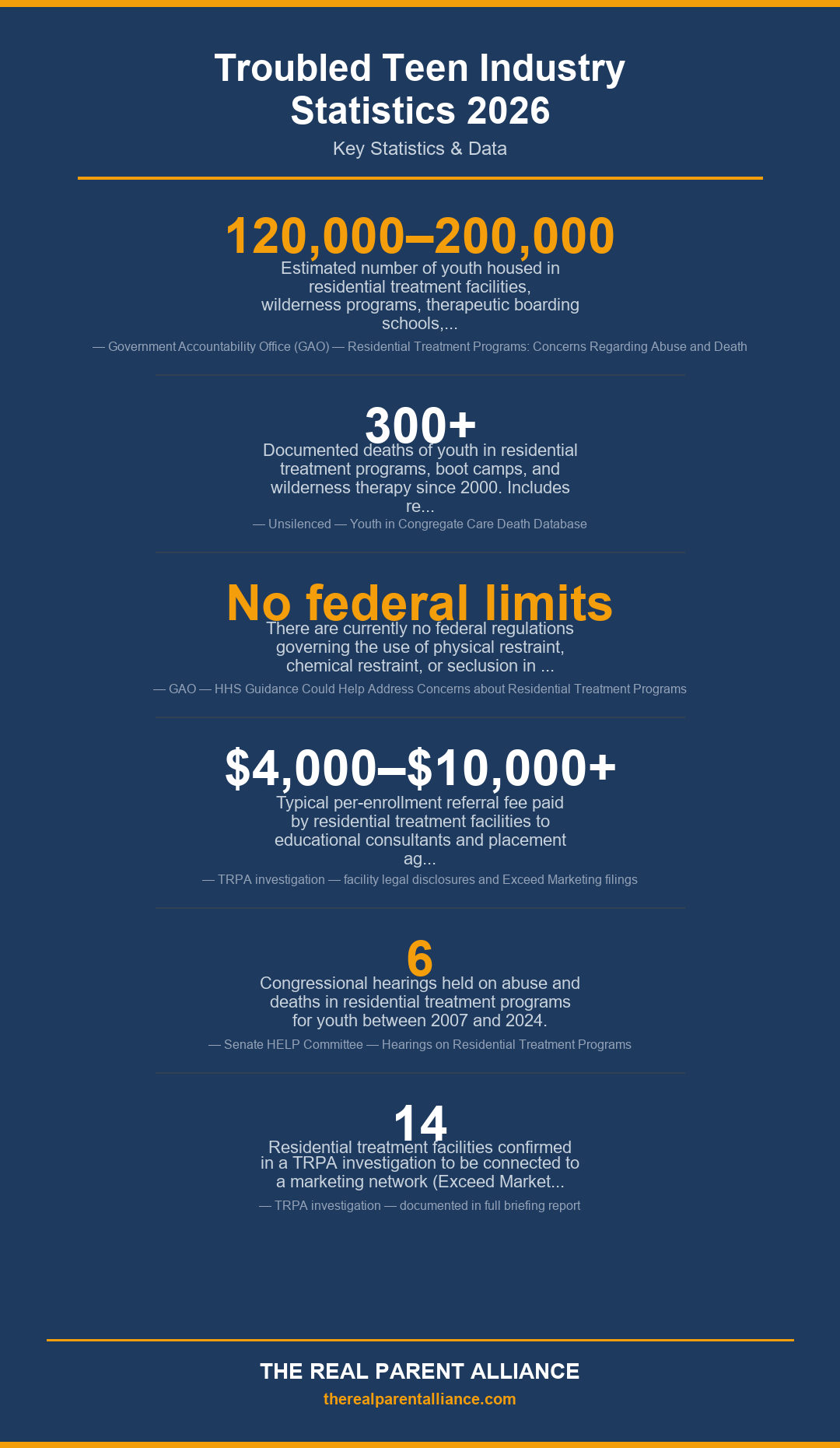
Download or share this infographic. If you use it on your website, please link back to this page as the source.
If your teen is in crisis and you're researching residential treatment options, TRPA offers independent placement guidance with zero referral fees. We charge for our expertise because we don't take money from facilities.
