Teen Residential Treatment Cost Statistics 2026
Last updated: April 2026
Residential treatment for teenagers is one of the most expensive interventions a family can pursue — and one of the least transparent in pricing. This page compiles publicly available cost data from federal research, industry surveys, and parent-reported experiences to give families and journalists a clear picture of what treatment actually costs.
Table of Contents
- How Much Does Residential Treatment for Teens Cost?
- How Much Does Each Type of Teen Treatment Program Cost?
- Does Insurance Cover Teen Residential Treatment?
- How Do For-Profit and Nonprofit Treatment Costs Compare?
- What Hidden Costs Should Parents Expect Beyond the Program Fee?
- What Do Parents Actually Pay Out of Pocket?
- How Much Does Teen Treatment Cost by Program Type?
How Much Does Residential Treatment for Teens Cost?
The average cost of residential treatment for adolescents ranges from $25,000 to $80,000+ for a typical 60–90 day stay. Daily rates average $878, though for-profit facilities charge significantly more than nonprofits.
$878/day
Average daily cost of residential substance abuse treatment for adolescents in the United States, based on a comprehensive analysis of treatment facility cost data.
Source: National Institute on Drug Abuse (NIDA) — Principles of Adolescent Substance Use Disorder Treatment (2024)
$25,000–$80,000+
Typical total cost range for a 60–90 day residential treatment program for teens. Costs vary widely based on program type, location, amenities, and whether the facility is for-profit or nonprofit.
Source: SAMHSA — National Survey of Substance Abuse Treatment Services (N-SSATS) Cost Data (2023)
$500–$1,500/day
Typical daily rate range for therapeutic boarding schools and residential treatment centers. Luxury or 'executive' programs can exceed $2,000/day.
Source: NATSAP — Research and Outcomes Data (2024)
How Much Does Each Type of Teen Treatment Program Cost?
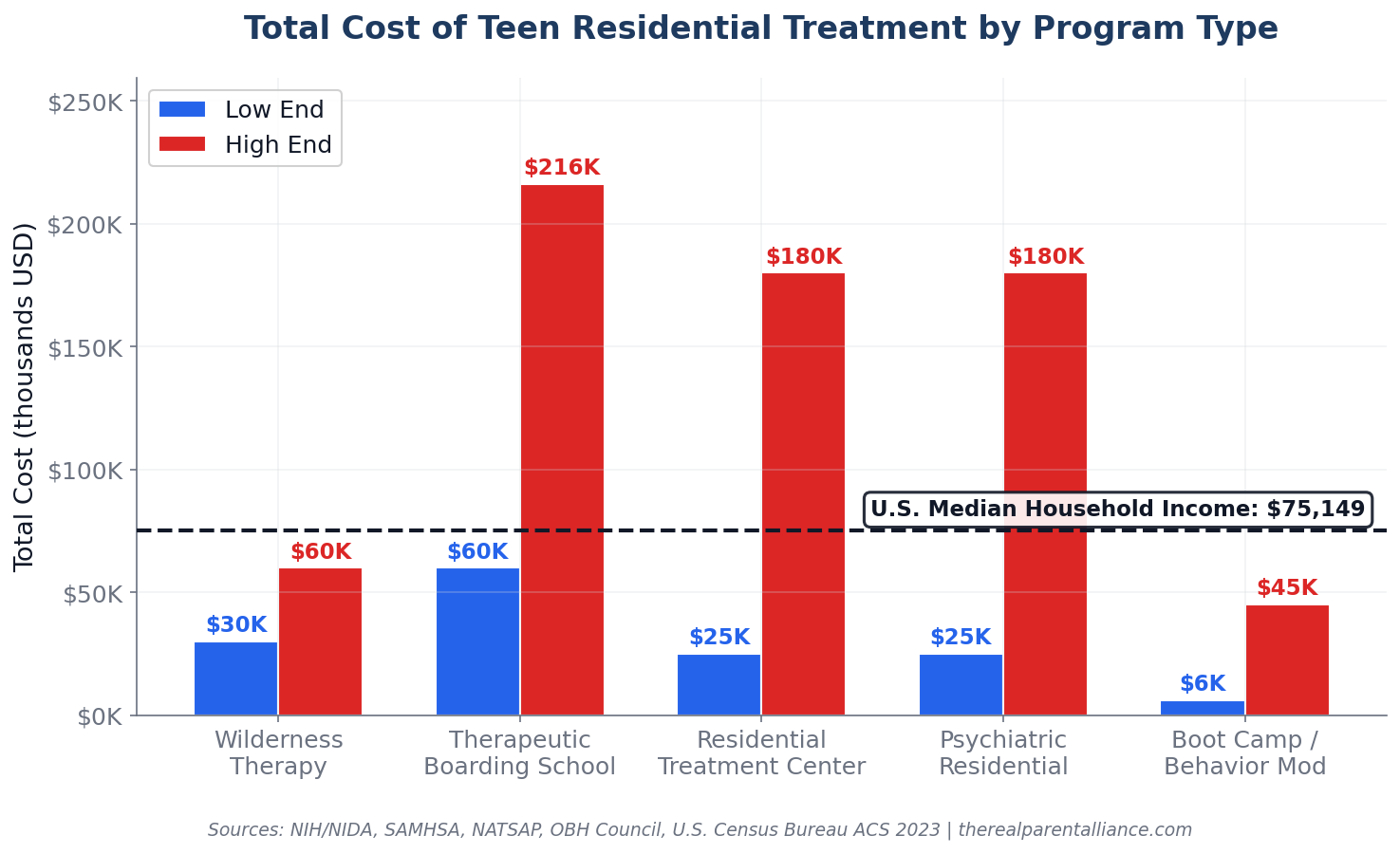
Wilderness therapy typically costs $500–$700/day for 8–12 weeks. Therapeutic boarding schools range from $5,000–$12,000/month. Residential treatment centers average $10,000–$30,000+/month depending on intensity of care.
$30,000–$60,000
Typical total cost for an 8–12 week wilderness therapy program. Programs generally include outdoor expeditions, individual/group therapy, and family sessions. Most insurance plans do not cover wilderness therapy.
Source: Outdoor Behavioral Healthcare Council — Research and Outcomes (2024)
$5,000–$12,000/month
Monthly cost range for therapeutic boarding schools. Average stay is 12–18 months, bringing total costs to $60,000–$216,000. Most therapeutic boarding schools do not accept insurance.
Source: NATSAP — Program Cost Survey Data (2024)
$10,000–$30,000+/month
Monthly cost for residential treatment centers (RTCs) providing intensive psychiatric and behavioral health services. Higher-acuity programs with psychiatric staff cost more. Some RTCs accept insurance for a portion of the stay.
Source: SAMHSA — National Survey of Substance Abuse Treatment Services (N-SSATS) (2023)
$148/day
Average daily cost of juvenile detention in the United States — significantly less than private residential treatment but funded by taxpayers. Annual cost per youth in juvenile detention: approximately $54,000.
Source: OJJDP — Juvenile Residential Facility Census (2022)
Does Insurance Cover Teen Residential Treatment?
Insurance coverage for teen residential treatment is limited and inconsistent. Only about half of residential treatment facilities accept private insurance, and many families report out-of-pocket costs of $30,000+ even with coverage.
48%
Percentage of residential treatment facilities for adolescents that require full upfront private payment, accepting no insurance.
Source: SAMHSA — FindTreatment.gov Facility Locator Data (2023)
21 states
States that have passed mental health parity enforcement laws requiring insurance companies to cover residential treatment for adolescents at levels comparable to inpatient medical care.
Source: NAMI — Mental Health Parity Laws by State (2024)
30–90 days
Typical insurance-authorized length of stay for residential treatment, even when clinical recommendations call for 6–12 months. Many families face the choice of pulling their teen early or paying out of pocket.
Source: Health Affairs — Managed Care Authorization and Length of Stay in Youth Residential Treatment (2023)
113 million
Americans living in mental health professional shortage areas, making outpatient alternatives to residential treatment inaccessible for many families — pushing them toward residential placement as a last resort.
Source: HRSA — Health Professional Shortage Areas (HPSA) Data (2024)
Note: The Mental Health Parity and Addiction Equity Act (MHPAEA) requires insurers to cover mental health treatment at parity with medical/surgical care, but enforcement is inconsistent and many families report denied claims for residential placement.
How Do For-Profit and Nonprofit Treatment Costs Compare?
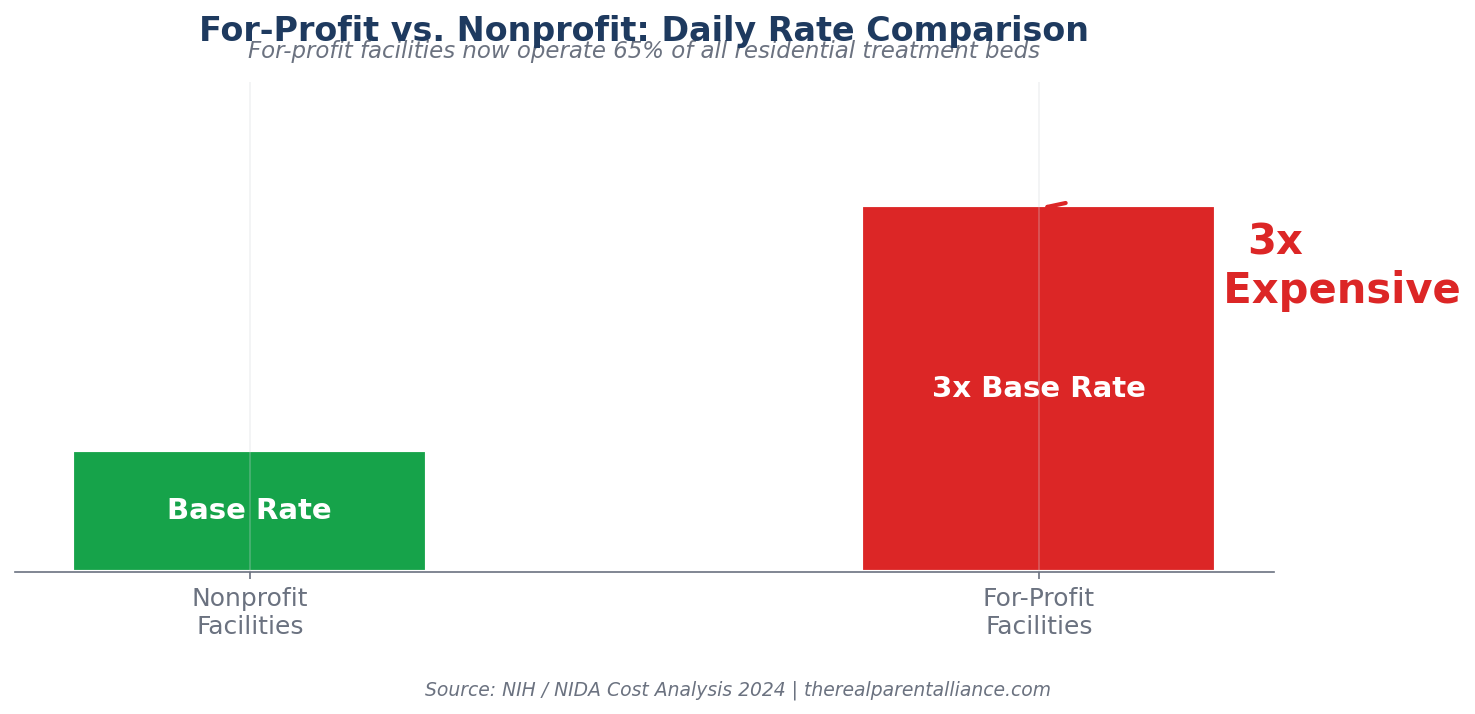
For-profit residential treatment facilities charge approximately 3 times more than nonprofit equivalents for comparable services, according to federal data. The for-profit sector has grown significantly while nonprofit capacity has declined.
3x
For-profit residential treatment facilities charge approximately three times the daily rate of nonprofit facilities providing comparable levels of care.
Source: NIDA — Economic Analysis of Adolescent Treatment Program Costs (2024)
65%
Percentage of residential treatment beds for adolescents that are now operated by for-profit entities, up from approximately 45% a decade ago.
Source: SAMHSA — N-SSATS Annual Survey of Treatment Facilities (2023)
10 states
States with zero publicly funded residential treatment beds for adolescents, meaning families in those states must pay privately or travel out of state.
Source: Annie E. Casey Foundation — KIDS COUNT Data Center (2023)
What Hidden Costs Should Parents Expect Beyond the Program Fee?
Beyond the base program fee, parents report additional costs of $5,000–$20,000+ for educational consultant fees, transport services, required aftercare programs, and mandatory family travel for visits and therapy sessions.
$4,000–$10,000+
Typical educational consultant fee for placement assistance. Some consultants also receive per-enrollment referral fees from the facilities they recommend, which are not always disclosed to parents.
Source: TRPA investigation — IECA industry data and facility legal disclosures (2026)
$5,000–$15,000
Cost of youth transport services. Many programs recommend or require professional transport — often involving waking the teen at night and driving or flying them to the facility. Transport is almost never covered by insurance.
Source: NATSAP — Parent Resource Guide on Transport Services (2024)
$2,000–$5,000
Estimated additional cost for required family participation — including travel for on-site family therapy weekends, mandatory parent workshops, and post-discharge aftercare planning sessions.
Source: TRPA parent-reported experience data from community surveys (2025–2026)
Note: Hidden costs are often not disclosed upfront. TRPA recommends asking for a complete cost breakdown — including transport, family travel, aftercare, and any consulting or referral fees — before committing to any program.
What Do Parents Actually Pay Out of Pocket?
Based on parent-reported data from TRPA families, total out-of-pocket costs for a single residential placement average $45,000–$120,000. Many families go through 2–3 placements, with cumulative costs exceeding $200,000.
$45,000–$120,000
Parent-reported total out-of-pocket cost for a single residential treatment placement, including program fees, consultant fees, transport, travel, and aftercare. Based on TRPA community data from families who placed teens between 2020–2026.
Source: TRPA parent-reported experience data (2020–2026)
2–3 placements
Average number of residential placements per teen before stabilization, according to parent reports. Each placement represents another $30,000–$100,000+ in costs.
Source: TRPA parent-reported experience data (2020–2026)
$588 billion
Total economic cost of untreated or inadequately treated mental health conditions among children and adolescents in the United States annually — including healthcare costs, lost productivity, and criminal justice involvement.
Source: NIH — National Institute of Mental Health: The Economic Burden of Mental Illness (2023)
Note: TRPA cost data is based on direct reports from families in our community. It is not a randomized study — it reflects the real experiences of parents who sought residential treatment for their teens. We include it because this type of granular cost data does not exist in any federal dataset.
How Much Does Teen Treatment Cost by Program Type?
| Program Type | Daily Rate | Typical Stay | Total Cost Range | Insurance Accepted? |
|---|---|---|---|---|
| Wilderness Therapy | $500–$700 | 8–12 weeks | $30,000–$60,000 | Rarely |
| Therapeutic Boarding School | $165–$400 | 12–18 months | $60,000–$216,000 | Rarely |
| Residential Treatment Center | $330–$1,000+ | 60–180 days | $25,000–$180,000 | Sometimes (partial) |
| Psychiatric Residential (high-acuity) | $800–$2,000+ | 30–90 days | $25,000–$180,000 | More likely |
| Boot Camp / Behavior Mod | $200–$500 | 30–90 days | $6,000–$45,000 | No |
| Juvenile Detention (public) | $148 | Varies | $54,000/year avg | N/A (taxpayer-funded) |
Share This Data
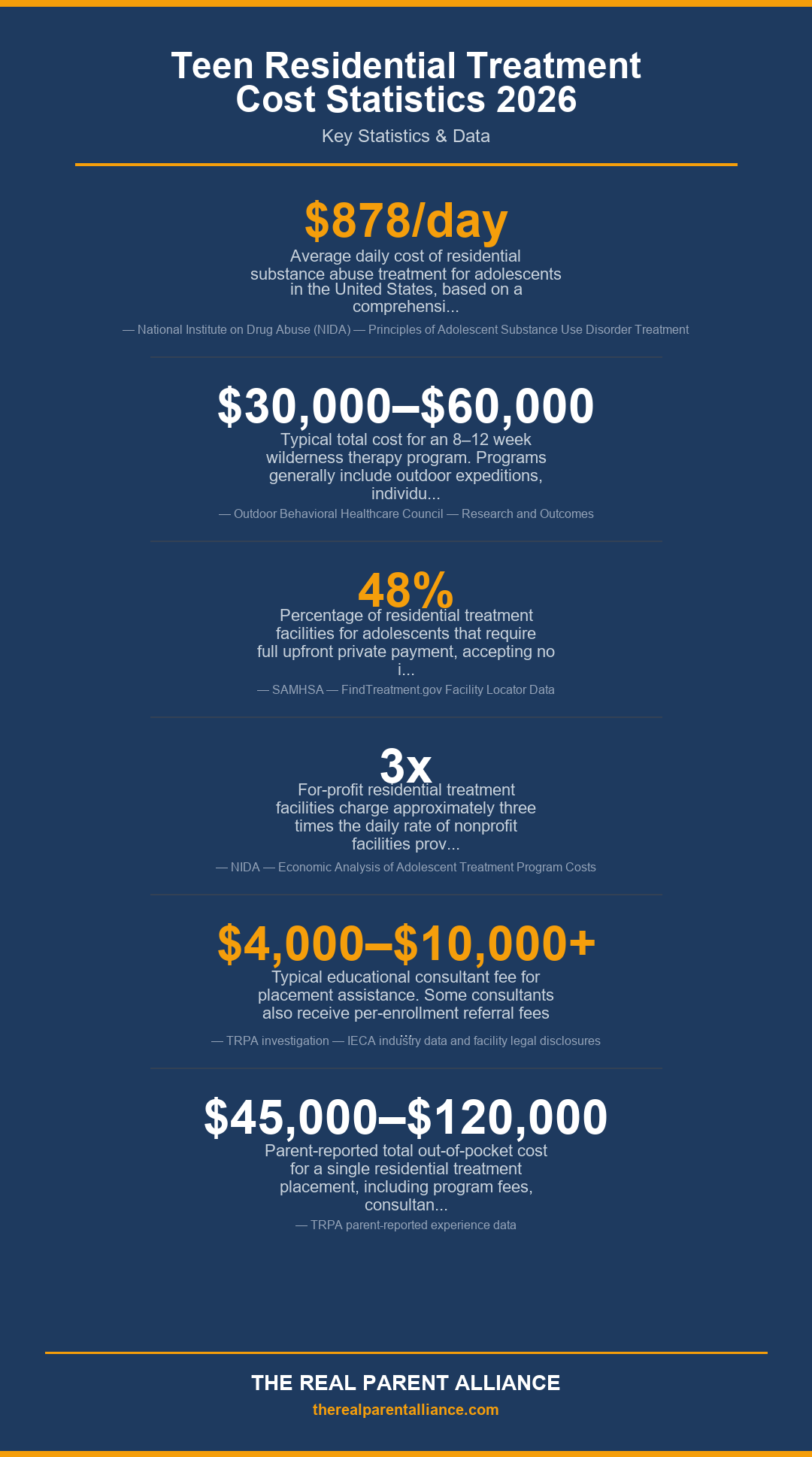
Download or share this infographic. If you use it on your website, please link back to this page as the source.
TRPA helps parents understand the real cost of residential treatment — including hidden fees that facilities don't advertise. Our Safe Placement Blueprint provides independent guidance with zero referral fees from facilities.
